
Conflagration

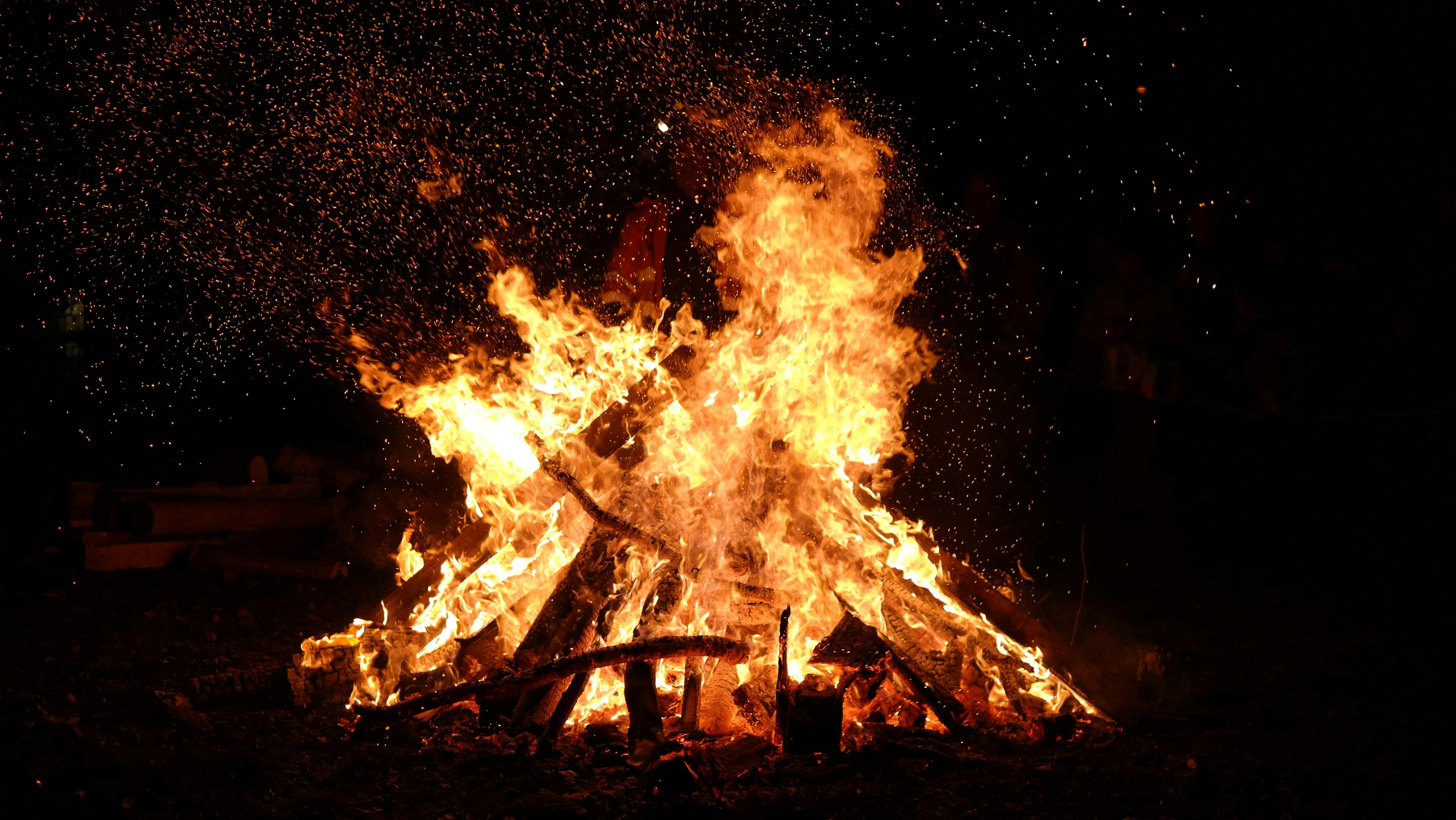
Fire illuminates and enlivens. From the sky and from the earth, the solar blaze and a campfire hand the world over to sight and imbue it with sense. They shed light and warmth. They make the world what it is. But they also blind and scorch when they are incredibly intense, their burning uncontrollable, their radiance intolerable. An ancient campfire morphs into the bonfire of global energy production. The sun in the age of the climate crisis is too hot. In a flash, the visible and the thinkable go up in flames.
The burning earth is a mirror image of the sun. Erupting volcanoes fleetingly reveal the inner sun of the earth, the small sun that is the earth, namely the overheated core of our planet. Lightning strikes throw fire from the sky onto the earth. The combustion of fossils is the burning of past suns, captured and turned into vegetal flesh via photosynthesis millions of years ago. The sun is burning: we burn the sun: the earth’s planetary burning is imitating the sun. Imitatio solis.
Wildfires are forest, bushland and grassland fires, except that there is no wilderness—least of all there where extensive plant communities are burning. Only fire itself is wild, inasmuch as it is nearly impossible to tame, fed by dry grasses, bushes or trees, fanned by the sweeping winds. The forests engulfed in the flames are the monocultures of eucalyptuses, pines, and other tree species in the service of paper mills, for instance. What is still wilder than a wildfire is the impulse to plant these impoverished plant communities without any regard for the ecological consequences of their proliferation in the age of global heating.
Fire empties out the world, reducing burnt matter to a minimum: to ashes and cinders. Airborne, unbearably light, the souvenirs of fire and of the things it consumed paint what remains of a world in broad brushstrokes of gray. Gray on gray. Rarefied to ash, what is burnt is still opaque: there is no translucent clarity there. The empty is overfull.
The bonfire of energy production (including the immediately lethal energy of bombs dropped and missiles launched in the currently multiplying wars) has heated up the planet, its atmosphere and the oceans. Even when they are ignited by a pair of human hands, forest fires are the effects of warmer, dryer climates, driven to the extreme. In the conflagration, everything is destroyed for nothing. Unless it is burning for something according to another, alien logic that has orchestrated the secular sacrificial burnt offering of the earth on the high altar of capital accumulation.
Sacrifice zones are silently earmarked for devastation because they sit on polluted soils or water sources; because they are situated on unstable ground or enveloped in unbreathable air. They are subject to a high risk (indeed, a near certainty) of flooding, burning, and other far-from-natural disasters. Everyone who inhabits them, whether human or not, is condemned to perish in advance. Not that long ago, sacrifice zones overlapped with the poorest socio-economic areas of a city or a region. Increasingly, they extend their tentacles beyond the initial calculus to wealthy areas, as well. The world is turning into one big sacrifice zone right before our eyes.
A catalogue of everything that burns, let alone of everything that is combustible, would be endless. To be a material thing is to be combustible. Ideas do not burn (though they may die away in irrelevance), but paper manuscripts containing them do. As fires spread, raging, they consume houses with all their contents and cars, trees and rodents, neighborhoods and ecosystems, human lives. The materiality of existence is affirmed and immediately denied in and by fires: all that burns is matter and… it is no longer. A sacrifice zone as wide as the world is burning with these affirmations and denials writ large.